Burl's Musings

My Photo
Name:
Location: Nashville, Tennessee, United States

Jesus-follower. Husband. Teacher. Avid reader, writer, and sports enthusiast.

Tuesday, January 24, 2012

Matthew 12--Sabbath

One thing that overwhelms me each time I try to write about my daily reading is the amount of content in the chapters in Matthew. There are so many powerful stories that are full of meaning, but where is the time to talk about all of them?

Matthew 12, though, has two stories about Sabbath, so Sabbath I shall write about. In the first story here, Jesus is walking through some wheat fields. The talmidim (disciples) get hungry, so they started picking heads of wheat and eating them. A Pharisee (who I guess was following Jesus as well) accuses Jesus’s talmidim of violating Sabbath. Rebuking the man with Scripture, Jesus tells of a time when David and his warriors also violated Sabbath. Quoting Hosea 6:6, Jesus reprimands the Pharisee, reminding him that God desires compassion (or mercy) over sacrifice. This story then closes with Jesus boldly claiming that “The Son of Man is Lord of the Sabbath.” (Matt. 12:1-8)

This idea carries over directly into the next story (seemingly on the same Sabbath) when Jesus is in a synagogue and he shows compassion on a man who has a withered hand. Some there, who were looking for a reason to accuse Jesus, ask Jesus if healing is permitted on the Sabbath. Jesus cuts directly to the heart of the issue with his response—he points out that if a sheep fell in a pit on the Sabbath that any one of them would help it out, and that when he heals someone, he is doing something more important than that because a man is more valuable than a sheep.

Jesus heals the man’s hand and the Pharisees begin to plot how to get rid of Jesus.

With Jesus attitude toward the Sabbath in these stories, as well as many others, one could get the impression that Sabbath is not important to Jesus. It would be easy to read this and say, “Get ‘em, Jesus! I don’t have to keep the Sabbath!” However, I don’t think that is what Jesus is saying at all.

Mark records these two stories in the same order (Mark 2:23-3:6), but he records an additional point that Jesus made: “And he said to them, ‘The Sabbath was made for man, not man for the Sabbath. So the Son of Man is lord even of the Sabbath’” (Mark 2:27-28, ESV).

This agrees with a rabbinic tradition that God didn’t just rest on the seventh day of creation, that he created rest. Rest isn’t something that naturally happens. God had to make room for it. And apparently, he made it for us. If he made it for us, then I would say that means we need it. The fact that it had to be made by God means that we, too, must make room for it.

Don’t think I’m advocating we keep Sabbath in exactly the same way Israel did. Obviously, in Jesus time at least, many had a misunderstanding of the purpose of the Sabbath, so it was abused and used to bind people. I think observing Sabbath, which was created for us, is intended to be a freeing action, and I firmly believe that observing Sabbath has a place in the Kingdom.

I’m also not saying that we should bind Sabbath only to Saturdays or to whole-day observance. We need to make room for being still in our lives. If that is one day a week, that’s great. If it’s a hour or two every day, that’s great too. My point is, we have to make time to be still.

At its heart, I feel like Sabbath is an act of faith. It’s an act of faith where we, as observers, are saying, “We didn’t create the world, and it can go on without us for now.” God is ultimately in control, and he made Sabbath for us.

As always, your comments are welcome. I might revise this a bit tonight... we'll see. :)

Labels: , ,

Sunday, January 22, 2012

Divine Intervention--Matthew 2

Do you ever pray for divine intervention? I'm not talking about hardcore-miracle divine intervention. Almost on a daily basis, I find myself asking what God's will is for me in certain situations. While it's always good to seek God's guidance, sometimes I feel like I'm copping out, waiting for some sign-from-above that isn't going to come.

In Matthew 2, there are lots of signs-from-above. The Magi (or stargazers) get a clear sign that they are to follow in the form of a star. Then they received another clear sign in a dream that they were not to return to Herod. Then Joseph gets a clear sign in the form of a dream telling him to take his family to Egypt. After they've been in Egypt for a while, Joseph had another dream telling him that Herod was dead and to return to Israel. Before they get to Israel, Joseph is told in another dream to stop in Nazareth. Each one of these divine interventions seems to fulfill God's will, at least his prophecy.
I can't imagine how amazing it felt to be in Joseph's shoes when he was travelling. Can you imagine receiving direct word from God himself telling you exactly what he wanted you to do? What assurance he must have felt. What confidence. I'm guessing Joseph wasn't worried about much on their trip to Egypt. I'd say the robbers and the desert didn't seem like that big of a deal when you are on a mission given to you directly from God.

There are a couple of responses I tend to have about passages like these.

On one hand, my first instinct is to say that God will tell me exactly what he wants me to do and when he wants me to do it. Often, I want God to paint the answer to my questions in the sky. Shoot, sometimes I'd settle for a dry sheepskin in the morning… This train of thought usually ends in nothing but frustration (and dewy sheepskins), though, because God's signs don't appear where or when I think they should.
On the other hand, the more I think about it, the more I am comforted by this passage and the divine intervention it recounts. Ultimately, God's will is done. Nothing can stop his purpose for this world. Our own free wills may cause him to redirect his path, but nothing can stop the ultimate ending. There is no distance he cannot overcome. No ruler that he cannot overpower. Certainly, my own ignorance can't stop him from using me for his purpose. If I am willing, then I am confident that God will make sure I accomplish his will for my life. If that means he sends an angel to me in a dream, that's awesome. It would be great to have the assurance that Joseph had that he was doing exactly as God wanted.

At the same time, isn't it also a blessing to be able to live only on the faith that God is working behind the scenes to make sure things work out? After all, for those who love God, he is working through everything to ensure that good happens (Rom. 8:28).

Joseph knew exactly the will of God for him at those moments, and that was absolutely a blessing. But isn't not knowing, and having to simply trust, in some ways a greater blessing? Jesus told Thomas, "Because you have seen me, you have believed; blessed are those who have not seen and yet have believed" (John 20:29 NIV).

Even though I may not get a clear sign from above, I know that when I submit my will to God's will-he will use that for his glory. Divine intervention or not, I know he will never leave me. I know that he is faithful. I know that he is working through all things for good. Whether that is miraculous or not, God is divinely intervening every day, every moment.

Labels: ,

Tuesday, March 15, 2011

Pruning


So it's been approximately two weeks since Nicoll and I started our some of our plants for our garden (obviously inside at this point in the year). You can see that some seeds have taken root and sprouted (two varieties of tomatoes and broccoli), while others haven't (eggplant and bell peppers). I'm sure there are dozens of verses in Scripture that I could muse over and ponder their meaning in light of my current experience with teaching and how some students listen and others don't, just like those seeds.

I think the thing that interests me more, though, is that today I had to prune out the extra plants from each little pot. Obviously, next year we won't sow quite as many seeds in a single area, but we're this time around, we're new at this. Anyway, in some squares we had as many as 7 or 8 little tomato plants sprouting. Unfortunately, I had to prune out most of those additional plants to ensure that they didn't choke each other out. Below lies the carnage:


Now that our garden is much... slimmer... than before, I can't help but think about how this process happens often in nature. Not only do we have to prune plants to ensure maximum fruit-baring, but many animals will kill the weaker of their offspring: for example, often a female dog will kill a puppy that she deems weaker in order to increase the chances for the other pups to survive.

And I can't help but wonder... why? What makes us root out the weak? How often do I do that in my own life with my students, focusing on the students who I feel like I can make the most impact on? With my own relationships? And how much of it is necessary? How much did Jesus prune his relationships to maximize his impact? Or did he prune them at all? Obviously, Jesus didn't heal every sick person that came to him; how did he choose? The same goes for the apostles. What in my life do I need to prune in order to maximize my resources and make the most impact? If I spread myself to thin, then I won't grow any deep roots and I will just wither away. But how do I make those decisions when there are so many godly works?

These are just a few questions I've been pondering. Feel free to post your thoughts, and I will post some of mine when I come up with some answers.
I welcome your thoughts, because all I have are questions today.

Labels: ,

Monday, March 7, 2011

You Are More

"You Are More" is the title of a song by Tenth Avenue North.

This song has some of my favorite lyrics, especially in the chorus. Here's a snippet:

"You are more than the choices that you've made,
You are more than the sum of your past mistakes,
You are more than the problems you create,
You've been remade."

This song affects me on many different levels. One of those is a professional level. Everyday I see students who have no hope. They feel helpless in their plight, and many of them feel doomed to a life of poverty at best and prison or an early death at worst.

These students, at least the ones I have had one-on-one conversations with, seem to feel like they have been labeled by the system as a troublemaker, and that there is nothing they can do to break that perception. At this point in the conversation, I typically try to help students see what they have done to develop that perception for themselves and what they can do to change it.

If only it were that easy. The system is against them. It's not just their perception. It's not just the result of their actions (although they play their part). The system historically labels people and treats them accordingly, and it makes me nauseous.

And I think the worst part for me is that it's not any one system. It's not just the education system; it's not just law enforcement; it's not just American society; it's not just a contemporary problem. The worst thing about it is that it seems to be able to be traced back across human history.

Perhaps since God marked Cain for his sin, we got in the habit of labeling people according to their actions.

But praise God that Jesus came and changed all of that. Because of Christ, I long to sing "You are more than the choices that you've made, You are more than the sum of your past mistakes,
You are more than the problems you create, You've been remade" to my students. Sadly, my job doesn't allow for that. At least, it doesn't allow me to tell them how Jesus has saved them.

On more than one occasion, I have had the opportunity to tell a student who had confided in me how he or she was perceived by teachers or others in authority that our mistakes don't define us--how we bounce back from them tell the world who we are.

I don't know how much it helps, but hopefully it at least plants a seed that there is something more in life: that there just might be hope for them, yet.

Just a few thoughts at the end of a Monday. Let me know what you think or try to clarify any of my fuzzy points. (like I said: It's the end of a Monday.)

Labels: ,

Thursday, March 3, 2011

Planting Seeds

For the last year-and-a-half, I have been teaching 7th graders. Occasionally, at the end of the day, I leave feeling frustrated because I don't see the results I want to see. However, I understand that teaching takes time. It's like planting a seed: the growing season is just a little longer in humans.

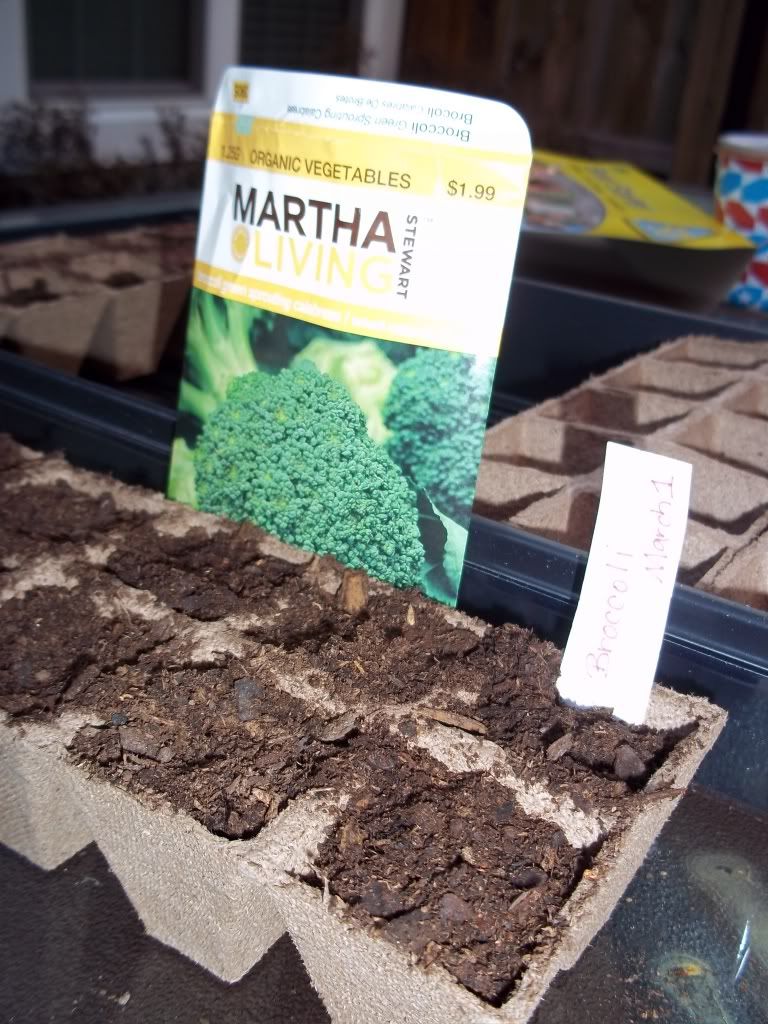
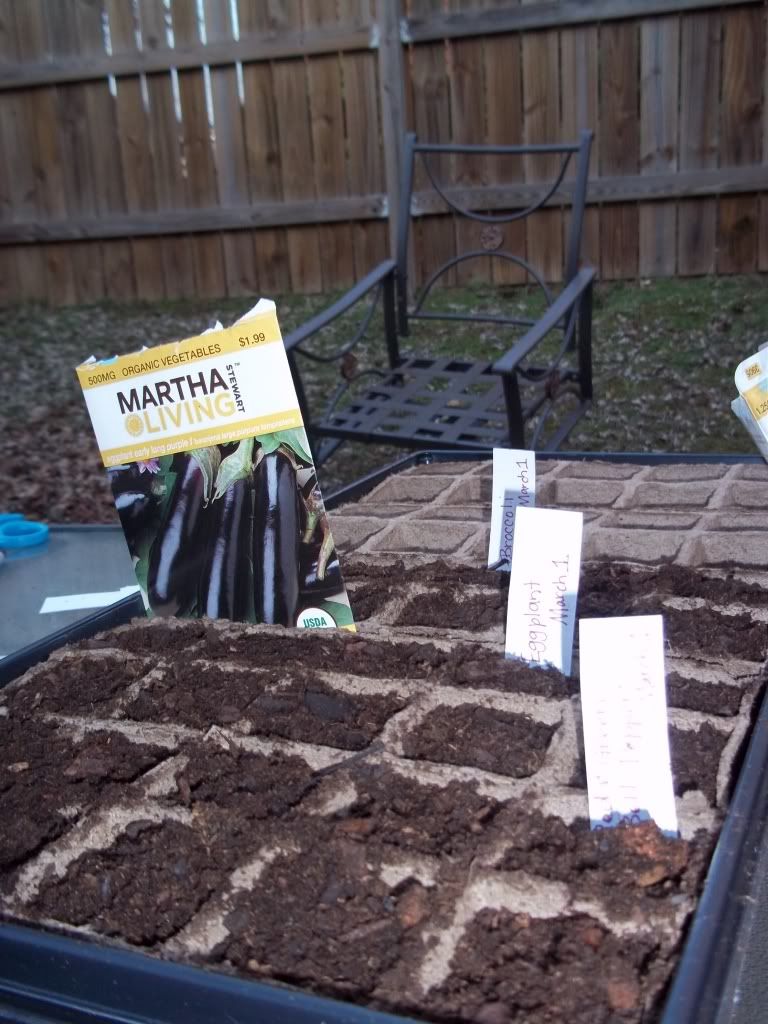
Today, Nicoll and I planted some seeds that we plan on transferring into a garden after the last frost.
We planted eggplant, bell peppers, and broccoli.

Hopefully, seeing the growth in our garden this year will help me to see the growth my students are experiencing in my classroom.


On a more spiritual note, for centuries monks (and others who are spiritually minded) have devoted themselves to tending gardens as a spiritual endeavor. There are many different spiritual lenses that one could use to look at gardening, but I want to focus on the aspect of penance.

When I speak of penance, I speak of the voluntary acceptance of doing (or not doing) something as a way of showing God one's penitence for his or her sin. In the book of Genesis, God cursed the ground because of Adam and told him "in pain you shall eat of it all the days of your life;
thorns and thistles it shall bring forth for you; and you shall eat the plants of the field."

The majority of my life I have eaten the fruits of the labor of others: both figuratively and literally. I have been in the work force for two-and-a-half years now, so for over 22 years I ate at the expense of others. And I certainly have never had to painfully work to grow the food I ate.

I say all that to say this: as I am planting seeds of knowledge in the minds of my students and I have come to understand what an arduous and painful process educating is, it has made me want to work for my food in a very concrete way--partially as professional development, but largely for penance for the sin that I have brought into the world.

I'm sure that there will be several more posts to come about gardening, planting, and growing as this process continues--there is certainly enough biblical material to go off of.

Just a few of my thoughts; yours are welcome in the comments.

Labels: ,

Tuesday, February 9, 2010

Jesus: The Only Model to Follow

About two weeks ago, I wrote an article titled Peace with God in a High-Stress Society. After sharing the link to the article on Facebook and Twitter, I received several encouraging comments about how the article was helpful. Unfortunately, I'm not good at modeling this behavior. Recently, I have been overwhelmed with work responsibilities and homework for my own graduate school classes. I'll admit: I have not been at peace with God.

As a first-year educator and graduate student, one of the first things I was told is that successful teachers model appropriate behavior as well as academic performance for students before expecting the students to perform any task. For instance, if I want my students to treat each other with respect, I should model for them what respectful interaction looks like in the particular setting we are in. If I want my students to write a five-paragraph essay, I should model for them how to write a five-paragraph essay before ever asking them to do so.

From time-to-time, I struggle to implement this in my classroom. More often than that, though, I fail to implement successful modeling in my spiritual life.

Thankfully, Jesus is a much better model for us. God himself came down and showed us the exact way we are to live in this life. If we continue to go back to Jesus' example, then we will see where we are falling short.

Looking back at Peace with God in a High-Stress Society and comparing how I have handled myself over the past few weeks, it is obvious that I am not living in the same type of relationship with God that Jesus did. Jesus constantly designated time to spend alone with God; I have not. When Jesus faced trials, he did not forget who was in charge: I have forgotten.

Lord, please forgive me for losing my focus over the past couple of weeks. I let the worries of this world overwhelm me and make me forget who is in control, who is most important in this life, and that is you, God. Father, never let me forget that you are, and that you are Lord. Help me to always place you first and to set aside time to spend with you every day. Jesus, help me to follow the example you set while you were on this earth. Spirit, bare the fruit of peace in me. Amen.

Labels:

Sunday, January 24, 2010

Peace with God in a High-Stress Society

Lately, I have been under stress.

"So what? Join the club," you might think. If that's your thought, then you probably don't know me very well.

By nature, I am a peaceful person. In the past, stress hasn't affected me. Even so, lately, I have found myself rushing from one responsibility to the next, and, in the end, looking back and trying to find time for things high on my priority list, much less leisure...

Between teaching full-time, preparing for teaching full-time, going to graduate school, and commuting in annoying traffic, my stress-level is so high that my battery is drained when it comes time to focus on the things that I feel are truly important to me in life: my relationship with God, my wife, and my friends (not to mention any hobbies).

It's not like I am alone in this, though. Quite frankly, many people have much more stress because of their work situations as well as additional responsibilities in their personal life than I do. So, what I am trying to say is this: Why do we live like this?

When I look at the society of America at large, it appears to be obsessed with busy-ness. The most disturbing aspect of this, however, is that most people don't seem to think it's a problem. When I talk to co-workers and friends, often I am reminded of how "normal" this high-stress lifestyle has become. Why does our culture feel this constant need to be doing something? What ever happened to leisure? Just ... relaxing? Just ... being? I want some peace!

But, I need to step back even further. My tendency is to associate this fast-paced, high-stress lifestyle with our American culture, which to some extent is fair and accurate; however, I feel like my tendency here is slightly biased from my travels through Europe where I personally encountered a more relaxed way of living that was full of peace. But, in all fairness, the same stress problem even exists in Europe as well, perhaps it is not as prevalent, but it is present nonetheless. My point is that the problem of living in this state of restless stress is as wide-spread and old as humanity itself and isn't limited to American society.

I propose that we try to live this busy fast, paced life because of a disconnect between us and the people we were made to be. Perhaps, we are all moving so fast and we submit ourselves to such high levels of stress because we know that if we slow down, we just might see what's missing: peace in a harmonious relationship with God. Humanity has lacked this peace since it fell out of harmony with God in the garden.

The psalmist paints God as a "refuge" from this tumultuous world, bellowing "Be still, and know that I am God" (Psalm 46:10, ESV). Maybe, just maybe, if we are still, we can't help but acknowledge that we are living out of harmony with the creator, God himself, and that we long for peace.

Jesus tells us, "Come to me, all who labor and are heavy laden, and I will give you rest.Take my yoke upon you, and learn from me, for I am gentle and lowly in heart, and you will find rest for your souls" (Matt. 11:28-29, ESV). In Jesus and his teaching, I can find peace and release from the burden of stress.

Thankfully, I'm not the first one to experience this trial. Jesus himself felt this burden. If you read through the gospels, you will see a consistent event: Jesus withdrawing himself from the hustle-and-bustle into the wilderness or the mountains to simply be with God. Mark records Jesus as saying, "" Come away by yourselves to a desolate place and rest a while" (Mark 6:31, ESV). For many were coming and going, and they had no leisure even to eat."

It is tempting to feel "well that's easy for him; He is God." But, I find comfort that Jesus, too, had to make time for leisure and his relationship with God. Jesus kept peace in his life by setting aside time, even with responsibilities pressing down on him from every angle, to spend with God. So that's what I have to do. I have to make time for what is important in life, including leisure; that is the only way I can have peace from the stress of this world.

Will I be as successful in my professional and educational pursuits? Maybe... but probably not. And that's okay, because the stress it induces is simply not worth me sacrificing my priorities. Sure, ungraded papers may mound up on my desk, and my GPA may fall a bit, and I my students may not have the highest test scores, but that's okay, too. Because, when all that is swept away, what will really matter? My relationship with God, my wife, and my friends; whatever else I do is gravy. Who knows, the added peace and absence of stress may actually improve my performance in the classroom as both a teacher and a student.

God, I pray that I never let the stress of day-to-day life keep me from nurturing my relationship with you, my wife, or my friends. Jesus, you know how this world can be; God, give me the strength and consistency to always set aside time for the important things in life. God, guide me in determining those priorities. Grant me your peace. Amen.

Labels:

Saturday, January 16, 2010

Trust in God's Wisdom; He Will Heal You

"Be not wise in your own eyes;
fear the LORD , and turn away from evil.
It will be healing to your flesh
and refreshment to your bones."
Proverbs 3:7-8

It's interesting how sometimes certain scriptures reverberate with me. So often, I catch myself trying to sound wise or even trying to be wise. When I trust in my own wisdom, however, I seldom turn away from evil.

Just as much as turning away from evil brings healing to my flesh, so turning toward evil brings destruction to my flesh. My own wisdom has mangled my flesh. Not in any physically observable way, but mangled nonetheless. Through all the times I turned to evil, I have entrenched my flesh in the path towards that evil. My own wisdom, ultimately, leads me down the same path every time.

When I lean on God's wisdom and turn away from evil, I begin to heal.
With each decision to lean on God's wisdom, I become less and less entrenched in the path toward evil, and, bit by bit, the healing continues.

God, help me trust in your wisdom, not my own. Turn me from evil. My flesh needs healing that only you can bring. Help me stay out of your way as you heal and refresh me. Amen.

Labels:

Monday, January 12, 2009

The Christian God Seen as Big Brother

Unfortunately, our western culture seems to have a gross misunderstanding of the Christian God. Many people seem to view God as an extreme version of Big Brother. If your not familiar with George Orwell's 1984, then I would encourage you to check it out.

For those who haven't read 1984, the book is set in a futuristic society (1984 was completed by Orwell in 1948, and the title of the book was arrived at by inverting the last two digits of the current year). This society has perverted Socialism to the extreme (Some have misinterpreted 1984 as an attack on Socialism. This interpretation is most certainly incorrect due to the fact that Orwell was a known advocate of Socialism; he simply did not like the Russian perversion of the social doctrine.). This government is extremely overbearing, monitoring people with television-like devices in every home. The government regulates when couples have sex (and sex is only allowed for procreation, not pleasure). The government controls literally every aspect of the people's lives. The government is personified in a figure known as "Big Brother". He appears on television advertisements, on posters plastered on every corner, in every elevator, and in every home. "On coins, on stamps, on the covers of books, on banners, on posters, and on the wrapping of a cigarette packet--everywhere. ... Nothing was your own except the few cubic centimetres inside your skull" (1984--Orwell: 29).

The way society at large views God is even worse than Orwell's Big Brother. Society's portratal of God is that he even wants to control those few centimeters in your head. Thankfully, this is not the biblical picture of God. Too long have Christians portrayed God as an angry tyrant, waiting to cast people into hell at the slightest sin. On the contrary, the biblical view of God is that of a loving father, who desperately wants a relationship with his lost child (c.f. Luke 15:11-32).

God does not use terror as a motivational tactic, like so many Christians have in the past. The Bible tells us, "God is love ... There is no fear in love; but perfect love casts out fear, because fear involves punishment, and the one who fears is not perfected in love" (1 John 4:16-18).

If you do not know God and do not know his love, I encourage you to seek him out. He is not someone to be scared of. God is not Big Brother. He is not looking for an opportunity to cast you into hell. God wants everyone to come to him and have a relationship with him (2 Peter 3:9). The only fear we should have of God is the fear of his absence because his presence is the only way to live a truly fulfilling life. If you do know him, but you have been living in fear, live in fear no longer. God loves you and you are his child. Be free to love those around you with his love!

Feel free to comment or ask questions. If you want to know more about God, please feel free to ask. I would love to help you or share some of my experiences with you.

God bless!

Labels: ,